Tuesday, 5 March 2019

Akshardham Temple

Akshardham Temple

While sightseeing in Delhi, a visit is necessarily suggested to Swaminarayan Akshardham – one of the largest Hindu temples in the world. Built by the BAPS spiritual organization, it’s a stunning architectural work made of the pink stone and white marble. Located on the banks of the Yamuna River, this temple has lots of exhibits for the visitors. There is an Abhishekh Mandap, Sanskruti Darshan, Sahajanand Darshan and Neelkanth Darshan where you can enjoy a cultural boat ride. The theme-based garden is really an exciting place to visit here. And while you are here, don’t forget to visit the Sahaj Anand Water Show.

The main attraction of the Swaminarayan Akshardham complex is the Akshardham Mandir. It rises 141-foot (43 m) high, spans 316-foot (96 m) wide, and extends 356-foot (109 m) long. It is intricately carved with flora, fauna, dancers, musicians, and deities.
Designed in accordance with the standards of Maharishi Vastu Architecture, it features a blend of architectural styles across India. It is entirely constructed from Rajasthani pink sandstone and Italian Carrara marble. Based on traditional Hindu architectural guidelines (Shilpa shastras) on maximum temple life span, it makes no use of ferrous metal. Thus, it has no support from steel or concrete.
The mandir also consists of 234 ornately carved pillars, nine domes, and 20,000 murtis of sadhus, devotees, and acharyas. The mandir also features the Gajendra Pith at its base, a plinth paying tribute to the elephant for its importance in Hindu culture and India's history. It contains 148 life sized elephants in total weighing a total of 3000 tons.
Under the temple's central dome lies the 11-foot (3.4m) high murti of Swaminarayan seated in abhayamudra to whom the temple is dedicated. Swaminarayan is surrounded by images of the faith's lineage of Gurus depicted either in a devotional posture or in a posture of service.Each murti is made of paanch dhaatu or five metals in accordance to Hindu tradition. The temple also houses the murtis of Sita Ram, Radha Krishna, Shiv Parvati, and Lakshmi Narayan
 

Entry fee: Free, separate fee to view exhibitions
Opening hours: 9.30 am to 6.30 pm, Closed on Mondays


An unforgettable India experience!. - See more at: http://www.letsgoindiatours.com

Highlights of the tour


We are professional and speak multiple languages.
• We know all the routes which we offer you and will not have any problem in reaching one monument to another.
• We are friendly and happy to share the Indian culture with you.
• We make sure that you visit all the monuments as per itinerary.


Contact US
Phone: +91 9958675122
Email: ramesh@letsgoindiatours.com

Sunday, 3 March 2019

Jantar Mantar

Jantar Mantar

Constructed in 1724 by Maharaja Jai Singh of Jaipur, Jantar Mantar is an astronomical observatory. Fascinating for their ingenuity, the instruments at Jantar Mantar can no longer be used accurately because of the tall buildings around. However, a visit to admire the science of Indian astronomy makes it one of the most visited tourist attractions in Delhi. The principal instruments of the observatory are the Samrat Yantra, the Jai Prakash, the Ram Yantra, and the Misra Yantra. There is also a temple of Bhairava, located near the building. It was also built by Maharaja Jai Singh II.

Entry fee: INR 5
Opening hours: Sunrise to sunset
Must visit: Central Park in Connaught Place and get a selfie with the largest Tiranga.

An unforgettable India experience!. - See more at: http://www.letsgoindiatours.com

Highlights of the tour

• We are professional and speak multiple languages.
• We know all the routes which we offer you and will not have any problem in reaching one monument to another.
• We are friendly and happy to share the Indian culture with you.
• We make sure that you visit all the monuments as per itinerary.

Contact US

Phone: +91 9958675122
Email: ramesh@letsgoindiatours.com

Saturday, 2 March 2019

India Gate

India Gate

India Gate is one monument that defines Delhi or India for that matter. It was built in 1931 as a memorial for martyrs of World War I and war in Afghanistan. At Rajpath, the structure looks amazing in evening lights. The gardens that line the structure are a must visit among the sightseeing places in Delhi.

If you are in Delhi on the Republic Day, you must visit the India Gate Parade which is really a prestigious and the most ceremonious event of India. Lots of international guests and national leaders are present on the occasion and pay tribute to the freedom fighters and great leaders of the country.


Few Essential Tips:

For the sightseeing tour at India Gate, the best time is from October to March. The weather is soothing this time to roam around.
If you are having a family trip, go for a picnic near India Gate. Bring packaged or cooked food and have fun.
Bus service is readily available to reach India Gate. Else, you can take rickshaw or shuttle rickshaw.


Entry fee: Free
Opening hours: Always open

An unforgettable India experience!. - See more at: http://www.letsgoindiatours.com

Highlights of the tour

• We are professional and speak multiple languages.
• We know all the routes which we offer you and will not have any problem in reaching one monument to another.
• We are friendly and happy to share the Indian culture with you.
• We make sure that you visit all the monuments as per itinerary.


Contact Us

Phone: +91 9958675122
Email: ramesh@letsgoindiatours.com

Friday, 1 March 2019

Taj Museum


TAJ MUSEUM


At a distance of 6 km from Agra Cantonment Railway Station, Taj Museum is one of the most popular museums in Agra and is located in the ground floor of western Naubat Khana, also known as Jal Mahal, with in the Taj Mahal complex.
 

The museum was established in 1982. It is a double storied building having a quadrangle projection outside and is built on a raised platform. It is a big museum comprising of two floors and has three galleries along with a chief hall. The museum displays various exhibits relating mostly to the construction of the Taj Mahal and to the period of its builders. Totally 121 antiquities are on display, which are broadly categorized as Mughal miniature paintings, manuscripts, government decrees, specimen of calligraphy, arms, utensils, plans and drawings of Taj Complex, paintings, specimen inlay work, marble pillars, etc.

In main hall the paintings of Shah Jahan and his favourite wife Mumtaz Mahal both on ivory, encased in ornamental wooden frame, replicas of coins minted in Agra are on display. Exhibits also include paintings from the famous Persian epic Shahnama of Firdausi, which is a manuscript of Chaihl Majlis.

The first gallery contains plans and colour drawings showing the salient features of the architecture of Tai Mahal. The most worthwhile is a site plan, front elevation of the tomb and other details are recorded on this site plan. The second gallery display some jade and porcelain objects like Quaran stand carved of Jade, a beautiful ornamented spouted vase carve of jade, mirror mounted on stone, bowl and dishes of Celadon ware. Arms like swords, daggers and a world map showing the places from where stones were imported for inlay work of Taj Mahal along with specimens of these semiprecious stones are also in display.

In third gallery important royal Farmans and documents, specimen of famous calligraphy of the period, two paintings of Taj Mahal by British artist Daniel in the year 1795 AD are displayed. An interesting order of General Perron of the period of Shah Alam II recording the details of the auction of fruits in the garden of the mausoleum of Taj ganj is also displayed.

Entry Fee: Rs. 5 for Adults.

Timings: 10 AM to 5 PM. Closed on Friday.

Highlights of the tour :

• We are professional and speak multiple languages.
• We know all the routes which we offer you and will not have any problem in reaching one monument to another.
• We are friendly and happy to share the Indian culture with you.
• We make sure that you visit all the monuments as per itinerary.

Contact US

Phone: +91 9958675122
Email: ramesh@letsgoindiatours.com

Thursday, 28 February 2019

CHINI KA RAUZA

 CHINI KA RAUZA

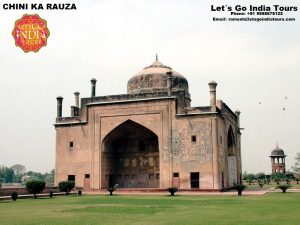
At a distance of 9 km from Agra Cantonment Railway Station and 1 km from Itimad-ud-Daulah Tomb, Chini ka Rauza is a funerary monument located on the banks of the Yamuna River in Agra.
 
Chini ka Rauza is the tomb of Afzal Khan who was a Persian poet during the reign of Jahangir. Later he became the wazir during Shah Jahan's reign. The tomb was built by him in 1635 AD. Khan died in Lahore in 1639 AD and was buried here at Agra. The name is derived from two Persian words Chini and Rauza that means glazed tiles tomb.
Also known as Chinese Tomb, Chini-ka-Rauza is considered a milestone in Indo-Persian architecture, as it is the very first building in India that has been exclusively decorated by the glazed tile works. The decoration is prominent on facade and exteriors. Each side of this square tomb building is about 79 feet in length. The central chamber is octagonal in shape with eight arched recesses including four pentagonal arches and four square openings in all four directions. This central chamber is inter-connected to the four square chambers in the corners with the side halls. The upper part of the tomb has been so constructed to give a double storeyed effect to the tomb building. The shallow dome crowning the building has inverted lotus and a kalash finial on its top and pinnacles on all the four corners.
 
Originally, the monument had high walls surrounding it, two main gateways in North and South, two three-storeyed octagonal towers and a ghat near the riverbank. However, only the ruins of the main tomb with a simple square plan and the ornamentation is not survived.
 
Timings: 6 AM to 6 PM
 

Highlights of the tour

• We are professional and speak multiple languages.
• We know all the routes which we offer you and will not have any problem in reaching one monument to another.
• We are friendly and happy to share the Indian culture with you.
• We make sure that you visit all the monuments as per itinerary.
 
Contact US
 
Phone: +91 9958675122
Email: ramesh@letsgoindiatours.com

JAMA MASJID- AGRA


JAMA MASJID- AGRA

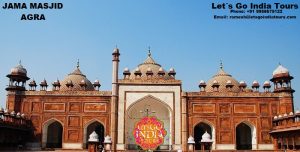
At a distance of 4.5 km from Agra Cantonment Railway Station, Jama Masjid is situated just opposite to the Agra Fort. It is also popularly known as the Jami Masjid or Friday Mosque and is one of the well known Agra tourist places.

Jama Masjid was built by Emperor Shah Jahan for his favorite daughter Jahanara Begum’s wish, at the cost of Rs 5 lakhs and took a period of 5 years in construction and was completed in 1649 AD. It is one of the largest mosques in India. The red sandstone structure was built in a typical Mughal style. It rests on a high plinth and is approached by staircase. It consists of a spacious elevated courtyard bordered by arched porticoes to the north and south, with a fountain at its centre. The eastern end was once also bordered by an arched portico and a grand entrance, but those were demolished by the British in 1857 while building the railway line to Agra.

The prayer hall occupies the western end of the courtyard and consists of a long rectangular structure, divided into five sections and crowned by three large domes. All the domes have inverted lotus and kalash finials on the top. Connecting the prayer hall to the courtyard are five archways, of which the central one is framed by a large iwan portico and a white marble facade with Persian calligraphy. Two short slender minarets, decorated in a zigzag pattern, once flanked the central archway, but the right side minaret was destroyed. A series of chhatris line the top of the facade.
The interiors of the western wall have a beautiful mihrab and pulpit in white marble. The Persian inscription in white marble inlaid with black stone on the archway of the central portal is in praise of Jahanara and Shah Jahan. It is said that once surrounded by a market place called Tripolia set in an octagonal (Muthamman) Chowk that was built between the Delhi Gate and the Jama Masjid. But, it was later destroyed in 1871-73 to acquire space for laying down the railway tracks for the city.
Every Friday, large number of Muslim devotees come here to offer their weekly prayers.

An unforgettable India experience!. – See more at: https://www.letsgoindiatours.com

Highlights of the tour

• We are professional and speak multiple languages.
• We know all the routes which we offer you and will not have any problem in reaching one monument to another.
• We are friendly and happy to share the Indian culture with you.
• We make sure that you visit all the monuments as per itinerary.

Contact US
Phone: +91 9958675122
Email: ramesh@letsgoindiatours.com

Monday, 25 February 2019

AKBARI MAHAL - AGRA FORT

AKBARI MAHAL - AGRA FORT

At a distance of 4.5 km from Agra Cantonment Railway Station and 2.5 km from Taj Mahal, Akbari Mahal or Akbar Palace is situated between Jahangiri Mahal and Bengali Burj inside the Agra Fort.
Currently in partial ruined state, the Akbari Mahal is a testimony presenting the gigantic imperial courts that have the spacious chambers. Akbari Palace was once a huge palace complex which was used for residential purposes. Built between 1565-69, it had a large stone paved courtyard enclosed on all sides by suites and chambers. Only the river-side apartments have now survived.


The Palace was designed and constructed in such a manner that whichever entrance the women used to enter the palace they were protected by purdah. The security and Purdah system was well designed in the palace. There was a great Assembly hall with a high ceiling on the lower storey, which can still be seen but the upper storey is completely in ruins. It also had a hall with triple opening on the riverside.
Akbar's Harem was housed in this palace. Historian Abul Fazal recorded that Akbar 'made a large enclosure with fine buildings inside, where he reposes. Though there are more than 5000 women. He was given each a separate apartment'. Chaste women and trustworthy officers were appointed in the service of the Harem. It was carefully guarded. Women were paid monthly salaries ranging from rupees 1028 to 1610 maid-servants were kept in large numbers for cleaning, lighting and other duties of the household. They received salaries from rupees 2 to 51. All this was well organized and kept in perfect order.
The Bengali Burj to its southeast has a spacious square hall with arched aisles. It has a domed ceiling and chevron design grace the nook shafts of the arches. The Akbari Baoli near Burj is actually a well with five rows of rooms around it and steps leading to the water. 

An unforgettable India experience!. - See more at: http://www.letsgoindiatours.com

Highlights of the tour

We are professional and speak multiple languages.
• We know all the routes which we offer you and will not have any problem in reaching one monument to another.
• We are friendly and happy to share the Indian culture with you.
• We make sure that you visit all the monuments as per itinerary.

Contact US
Phone: +91 9958675122
Email: ramesh@letsgoindiatours.com