Sunday, 17 July 2016

Shah Jahani Mahal

Shah Jahani Mahal


The Shah Jahani Mahal is part of the Agra Fort in northern India.
It is situated between the white marble Khas Mahal and the red stone Jahangiri Mahal and is set, transitionally, in between these two major residential complexes of two different ages. It is the earliest attempt of the Mughal Emperor Shah Jahan to convert an existing redstone building in accordance with his taste. It is his earliest palace in Agra Fort and has a large hall and side rooms, and an octagonal tower on the river side.
The skeletal construction of the brick masonry and red stone were all white, stuccoed with a thick plaster and colourfully painted with floral designs. The whole palace once glistened white, like white marble.
On its face towards the Khas Mahal is a white marble dalan, composed of five nine-cusped arches supported on double pillars and protected externally by a Chhajja. Its western bay was closed to house the Ghaznin gate. Babur's baoli and well are situated beneath it. The subterranean apartments in several stories are also situated under this palace.
----------------------------------------------------------------------------------
We ‪#‎specialize‬ in ‪#‎tours‬ in and around ‪#‎DelhiTour‬, world famous‪#‎TajMahalTour‬, the most ‪#‎famous‬ and popular ‪#‎GoldenTriangleTour‬, The colorful state of ‪#‎RajasthanTour‬, and the ‪#‎Heritage‬ and ‪#‎culturetour‬ in North ‪#‎India‬.With us you can experience the real India, its life, people, culture and history with excellent prices. ‪#‎letsgoindiatours‬
An unforgettable India experience!. - See more at:http://www.letsgoindiatours.com


Wednesday, 13 July 2016

Jahangiri Mahal

Jahangiri Mahal, may be the most noteworthy building inside the Agra Fort of India. The Mahal was the principal zenana (palace for women belonging to the royal household), and was used mainly by the Rajput wives of Akbar. It is a blend of Hindu and Central Asian architecture.
History
The palace was built by the emperor Akbar. It is one of the earliest surviving buildings of Akbar's reign. Jahangir in his memories has clearly mentioned that the buildings were erected by his father Akbar but did not take any credit for the construction of a palace like Jahangiri Mahal. Mughal empress Nur Jahan used this as her residence.
There is a huge bowl called Hauz-i-Jahangiri that is carved out of a single piece of stone. This was used as a container for fragrant rose water.
-----------------------------------------------------------------------------------
We ‪#‎specialize‬ in ‪#‎tours‬ in and around ‪#‎DelhiTour‬, world famous‪#‎TajMahalTour‬, the most ‪#‎famous‬ and popular ‪#‎GoldenTriangleTour‬, The colorful state of ‪#‎RajasthanTour‬, and the ‪#‎Heritage‬ and ‪#‎culturetour‬ in North ‪#‎India‬.With us you can experience the real India, its life, people, culture and history with excellent prices. ‪#‎letsgoindiatours‬
An unforgettable India experience!. - See more at:http://www.letsgoindiatours.com


Top 6 Attractions In Jaipur – The Pink City


Top 6 Attractions In Jaipur – The Pink City

If you love palaces and crave to have an insight on the lifestyle of the rulers of the bygone era, Jaipur is the city for you. If you are passionate about the strong forts and marvelous architecture that flaunt the expertise of the artisans of the past, Jaipur is where you need to be on your vacation. If you long to experience the flamboyant lifestyle of the past rulers even if it is only for a few days, Jaipur’s palaces-turned-heritage hotels are where you need to stay for a lifetime experience. If you fancy elephant rides, you need to be in Jaipur to have a royal ride on the elephants. You can customize the rides the way you need, take elephant rides on jungles, through villages, in Biological Park and many more. If these were not enough to decide in favor of Jaipur, go ahead to have a look at the top list of attractions in Jaipur and you cannot resist any more.
1. Pink City
To experience the originality, to experience the traditional touch of the glorious past, your stop should be at old city, famously known as the Pink City, which is famous for magnificent palaces. The founder was Sawai Jai Singh II. To offer cordial welcome to Prince of Wales in 1876, the entire city was painted in pink color, which resembles hospitality. You cannot help marvel the architectural brain as the construction of the city was planned on providing excellent ventilation through out. You will love the exclusive artwork in the jewellery. You need to commence your Jaipur tour from Pink City, considered the first planned Indian city.
2. City Palace
Once you are in Pink City, you will naturally be inclined to visiting City Palace, which is situated in Pink City. It was constructed by Sawai Jai Singh II between 1729 and 1732 AD. The palace complex comprises of Chandra Mahal and Mubarak Mahal. Now, Chandra Mahal has been converted into museum that houses exclusive handcrafted products and other products that depict the cultural heritage of the kingdom. Not only will you enjoy the architecture, you will be awe struck by the glorious view of Pink City from here.
3. Hawa Mahal
A stunning presentation of the rich architectural expertise of the past, Hawa Mahal is a not-to-miss tourist places in Jaipur. The Mahal was constructed by Maharaja Sawai Pratap Singh in 1799. True to the name it earned as the ‘Palace of the Winds’, Hawa Mahal has 953 windows to provide ventilation. The five-storey building does not have steps to reach upper floors. Slopes connect the storeys and it is said that the Mahal was constructed to enable the Royal women of Rajput family to view the happenings in the city. You would want to visit the archeological museum in Hawa Mahal during your visit.
4. Amber Fort
Also known as Amer Fort, it is located in Amer, which is around 11 kilometers from Jaipur. It was constructed by Raja Mansingh in the year 1592. It was later expanded by Raja Jai Singh I. The red sandstone and marble stone construction reflect a blend of Hindu-Muslim architecture. The main entrance faces east and there are three more entrances. There are four courtyards in Amber Palace. One of the courtyards has the Public Audience Hall, called the Diwan-i-AAm. The place provides you an opportunity to ride on elephant. Though it is only a ten-minute walk to the fort, which is uphill, you will want to try it on an elephant. 
5. Jantar Mantar Observatory
If you have any doubts about having to spend your time at an observatory on your tour, reconsider it. Jantar Mantar is not just like any other average observatory; it is ranked amongst the largest observatories of the world. Built during the period of Maharaja Jai Singh II, the astronomical observatory has the largest sundial of the world. Maharaja Jai Singh II had avid interest in various subjects including architecture, astronomy, philosophy and astronomy. His keen interest in astronomy led him to construct the country’s largest observatory. The geometric devices available here are used in measuring time, observing constellations and orbits around the biggest star. The astrological instruments attract astronomers and architects from all parts of the world. Whatever your level of interest in space, you will be inspired by Jantar Mantar Observatory.
6. Dera Amer Elephant Safari
Being in Jaipur, you would not want to miss elephant safari. If you are keen to engage the adventurous spirit in you, the hills behind Amer fort is the right place. This is where Dera Amer is situated and it is the foothills of Aravali Range. You will enjoy the elephant safari in the serene atmosphere. The ride will take you through fields, fortress and to the camp in the middle of Aravali forests. The picturesque landscape and the stunning beauty of the forest will elevate your spirits. If you love to experience your adrenaline rush, you need to opt for night safari. Whichever time you choose, you will be provided excellent meals that would keep your taste buds engaged.
---------------------------------------------------------------------------------
We ‪#‎specialize‬ in ‪#‎tours‬ in and around ‪#‎DelhiTour‬, world famous‪#‎TajMahalTour‬, the most ‪#‎famous‬ and popular ‪#‎GoldenTriangleTour‬, The colorful state of ‪#‎RajasthanTour‬, and the ‪#‎Heritage‬ and ‪#‎culturetour‬ in North ‪#‎India‬.With us you can experience the real India, its life, people, culture and history with excellent prices. ‪#‎letsgoindiatours‬
An unforgettable India experience!. - See more at:http://www.letsgoindiatours.com

7 FACTS ABOUT DELHI, INDIA

7 FACTS ABOUT DELHI, INDIA

Delhi isn’t just a must-see city on a tour of India; it’s an important place in the country’s past, with many layers of history spanning not merely centuries, but millennia. Today, we take a look at some interesting lesser-known facts about this fascinating city.
1. Delhi has been continuously inhabited since the 6th century BC
Delhi’s long and colourful history begins around the 6th century BC, and the many centuries since have seen it invaded, occupied, plundered and rebuilt on numerous occasions. The Medieval period was particularly turbulent, and over the course of its history it’s been a capital city for a number of different empires. It’s thought that the history of the site stretches back even further, into prehistory; there’s probably been a settlement here for at least three thousand years.
2. Delhi has a possible place in legend
The Sanskrit epic poem Mahabharata - thought to date back to the 8th or 9th century BC and said to be the longest poem ever written - talks about a place called Indraprastha, the capital city of the Pandavas, which was built on the site of a burned-down forest called Kandavaprastha. Some believe that this city was located at Delhi, and it’s often associated with Purana Qila, an old fort of Delhi.
3. The seven cities of Delhi - or is it eight?
Traditionally, historians refer to “the seven cities of Delhi”, because over the centuries several different dynasties have had their capital cities located here, each built around a fortress that doubled as a palace. Archaeological remains in the Delhi area, however, point to at least eight different major cities between AD 1100 and 1947.
4. It’s one of the greenest cities in the world
Picture Delhi, and you’ll probably imagine chaotic streets heaving with people and cars, with a large number of tuk tuks thrown in. So it may come as a surprise to learn that Delhi is actually considered one of the greenest cities in the world. Its comprehensive bus system runs on Compressed Natural Gas, which is kinder to the environment, while 20% of the metropolis is given over to greenery, including trees and parks.
5. You’ll find (not quite) the world’s largest brick minaret in Delhi
Built in the 13th century by Delhi’s first Muslim Sultan, the Qutb Minar is an imposing brick minaret purporting to be the world’s largest. It’s actually India’s second tallest, but that doesn’t detract from the impressiveness of its ornately carved red sandstone. While it’s certainly something to see when you’re in Delhi, you’re unfortunately out of luck if you were hoping to enjoy the views from its uppermost level: the top, accessed by 379 steps, has been closed to the public since a lethal stampede in 1981.
6. Delhi’s weirdest museum celebrates the toilet
Delhi has many fascinating museums, housing artifacts, art and all kinds of other priceless treasures spanning India’s long and eventful history. But Delhi is also home to a museum celebrating something rather more mundane: the toilet. Not that it’s likely to be high on your list of things to visit when you’re in Delhi, but it displays examples of examples of every kind of toilet you could imagine, including a replica of that used by King Louis XIV of France. Behind this quirky landmark is a serious message, however; it’s a way of highlighting India’s major issue with sanitation.
7. Delhi’s Jantar Mantar: astronomy on an architectural scale
One of Delhi’s most interesting landmarks is the Jantar Mantar, a collection of 18th century architectural astronomical instruments built in 1724 by Maharajah Sawai Jai Singh. There are three instruments, and they were used for measuring the path of the moon and sun, for drawing up astronomical tables and calendars, and to predict eclipses. Similar observatories were built in other Indian cities, most famously in Jaipur.
-------------------------------------------------------------------------------
We ‪#‎specialize‬ in ‪#‎tours‬ in and around ‪#‎DelhiTour‬, world famous‪#‎TajMahalTour‬, the most ‪#‎famous‬ and popular ‪#‎GoldenTriangleTour‬, The colorful state of ‪#‎RajasthanTour‬, and the ‪#‎Heritage‬ and ‪#‎culturetour‬ in North ‪#‎India‬.With us you can experience the real India, its life, people, culture and history with excellent prices. ‪#‎letsgoindiatours‬
An unforgettable India experience!. - See more at:http://www.letsgoindiatours.com


Top 8 Markets in Delhi

Top 8 Markets in Delhi

The vibrant and exotic atmosphere of Delhi markets can make shopping lots of fun. In fact, Delhi has the best markets in India, with handicrafts from all over the country. These top markets in Delhi are a treasure trove of goods waiting to be discovered.
1. Dilli Haat
This huge Delhi market has been deliberately made to feel like a traditional weekly village market, called a haat. Small thatched roof cottages with a village atmosphere give it great ambiance. The market offers an exciting blend of handicrafts from all over India, food, and cultural and music performances. Don't miss it!
Location: Opposite INA Market, south Delhi. Pitampura, north Delhi. Janakpuri, west Delhi.
Opening Hours: Daily from 11 a.m. to 10 p.m., including national holidays.
What to Buy: Indian handcrafts and artifacts.
2. Janpath and Tibetan Market
This very popular and lively Delhi market, which was recently given a makeover, has something for everyone. You'll find goods from everywhere in India and Tibet here, and it's a great place to shop for things to take back home. However, you'll need all your bargaining skills to get a really decent price.
Location: Janpath, just off Connaught Place, in central New Delhi.
Opening Hours: Daily.
What to Buy: Handicrafts, hippy clothing, shoes, paintings, brassware, Indian artifacts, leather work, and cheap jewelry.
3. Paharganj
Some of the best bargain shopping in Delhi can be found in the crumbling and chaotic Main Bazaar of the Paharganj traveler ghetto. Many of the shops in Paharganj also deal in wholesale and export to foreign countries, making it a good place to come and hunt out unique and inexpensive goods to import back home.
Location: Paharganj Main Bazaar, opposite the New Delhi Railway Station.
Opening Hours: Daily until around 9 p.m.
What to Buy: Clothes, shoes, jewelry, books, music, textiles, handicrafts, hookah pipes, incense.
4. Chandni Chowk
The shopping district of Chandni Chowk has been in existence for hundreds of years and an exploration of its winding, narrow alleyways is certainly an adventure. The lanes of Chandni Chowk are divided into bazaars with different areas of specialization. For fabrics, head to Katra Neel. In the Bhagirath Palace area, you'll find a huge range of electronics. Dariba Kalan is Old Delhi's ancient silver market full of silver jewelry. Kinari bazaar sells everything you need for a wedding, including saris. Khari Baoli Road has Asia's largest spice market. Food vendors in Chandni Chowk also serve up a delicious assortment of Delhi street food.
Location: Old Delhi.
Opening Hours: Daily except Sundays.
What to Buy: Fabrics, jewelry, spices, and electronic goods.
5. Sarojini Nagar
Sarojini Nagar is most famous for its really cheap designer clothes and reputable brands that have been rejected from export, either because of surplus quantity or small manufacturing defects. Shops and stalls, selling all kinds of clothes and fashion accessories, sprawl onto the streets. There's also a sweet market (Babu Market) and vegetable market (Subzi Mundi) in the area.
Location: South West Delhi, near Safdarjung Airport.
Opening Hours: Daily except Mondays.
What to Buy: Designer clothes, Indian clothes, fashion accessories, shoes.
6. Khan Market
Khan Market is a small, U-shaped, well established market that's one of Delhi's classiest. Bargain hunters are likely to be disappointed at this market. It's got a loyal following who go there to shop at its branded outlets. One of the best things about this market is its interesting book shops. It's also got some excellent tailors who will make you a suit in less than a week. For Ayurvedic food, medicine and skin care check out Biotique, and Khadi. Hidden away, you'll find some great lounges to relax in, many with balconies overlooking the street.
Location: South New Delhi, not far from India Gate.
Opening Hours: Daily except Sundays.
What to Buy: Books, music, branded and tailored clothes, Ayurvedic food and cosmetics, and lamps.
7. Lajpat Nagar (Central Market)
The hectic Lajpat Nagar market provides an interesting glimpse into Indian culture. It's one of the oldest markets in India and is abuzz with middle class Indian shoppers, all swarming around its roadside stalls and showrooms. One of this market's main attractions is the Mehendiwalas, who will apply beautiful henna designs to your hands with astonishing speed. You'll also find reasonably priced Indian kurti tops and salwaar kameez suits here.
Location: South New Delhi, near Defense Colony (between Greater Kailash and South Extension).
Opening Hours: Daily except Mondays.
What to Buy: Indian clothing, shoes, bags, accessories (including Indian bangles), and home furnishings.
8. Sunder Nagar
This quaint market attracts quite a few rich Indian socialites because of its art and antique shops. It's a well-designed market in an upscale neighborhood. You'll also find some wonderful tea shops there. Try the Regalia Tea House and Mittal Tea House.
Location: Off Mathura Road in central New Delhi, not too far away from Connaught Place, near the zoo and Oberoi Hotel.
Opening Hours: Daily except Sundays.
What to Buy: Silver jewelry, art, textiles, carpets, and antiques.
----------------------------------------------------------------------

We ‪#‎specialize‬ in ‪#‎tours‬ in and around ‪#‎DelhiTour‬, world famous‪#‎TajMahalTour‬, the most ‪#‎famous‬ and popular ‪#‎GoldenTriangleTour‬, The colorful state of ‪#‎RajasthanTour‬, and the ‪#‎Heritage‬ and ‪#‎culturetour‬ in North ‪#‎India‬.With us you can experience the real India, its life, people, culture and history with excellent prices. ‪#‎letsgoindiatours‬
An unforgettable India experience!. - See more at:http://www.letsgoindiatours.com

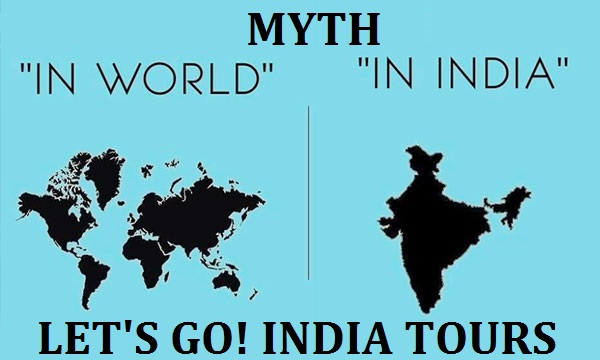
Top 5 myths about India

Top 5 myths about India


Myth #1: Traveling in India is dangerous

Before I went to India for the first time, I was warned to my teeth about how dirty and dangerous India is, especially by the doctor at the travel medical clinic. She really tried to put the fear of disease into me, and I went to India the first time loaded with precautionary supplies, pills and additional health insurance. Then I landed in Delhi at the very civilized home of my friend Ajay, who lives with his family in the Delhi equivalent of Forest Hill (one of the most upscale neighbourhoods in Toronto), and they laughed at all my stuff. When I did get sick I went to the local Max Medical Centre and after waiting about 10 or 15 minutes I got to see the British-trained head of internal medicine. The medical centre was spotlessly clean, modern and efficient, better than almost anything I’ve seen in Canada, and the visit cost 500 rupees or about $10.
At this point in my journey, about 10 days in, something began to dawn on me. I realized that many people in Canada, including me, were of the idea that India is a barbaric place. In fact, I found it to be very civilized. I no longer carry all those supplies and pills, I no longer buy extra health insurance. I practice caution, but I don’t assume the worst, I assume the best. And guess what?
This is what I have come to believe through my own experiences and those of many people I know: India will mirror back to you your own attitude, feelings, prejudices, barriers and limitations – and India will evoke your higher self, too. It can be very painful to see how impatient, judgmental, middle-class, naïve and unkind you can be! And very uplifting to discover your compassion, open-mindedness and spiritual awareness.
But I really do believe India knows best. India is like a guru who gives you the experiences you need to move you along your path. I often say that going to India is like that scene in Star Wars when Yoda sends Luke into the cave. Luke asks, “what will I find there?” and Yoda answers, “only what you bring in with you.” So if you are afraid, you will have scary experiences. And if you are open and trusting (within reason), you will find kind, helpful people who can really help smooth over the unavoidable challenges to travel in India.

Myth #2: India is a country

India is often called the subcontinent, and there’s a reason. It is more like a continent or the European Union than a country like Canada, which is fairly homogenous from one end to the other, multiculturalism, natives and Newfies notwithstanding.
In fact, not so long ago – before and even during the Raj, the British colonial period – India was a nation of princely states, not unlike the city states of Italy; and before that, powerful rulers – who often attained that power through conquest and invasion – reigned over vast tracts of the country. The result is that India is an extremely diverse nation. As you travel from one part of the country to another, you meet people with very different linguistic, cultural and even ethnic backgrounds. In the south, the people are descended from the Dravidian culture. In the north, which was subject to many more waves of invaders and conquerors, the people are of Aryan descent. Rajputs from Rajasthan are about as similar to the Christians of Goa as an English peer is to a Greek fisherman.
There are 14 official languages – each state has its own official language – and just about every religion the world has to offer. Four of the world’s great religions were born in India – Hinduism, Buddhism, Sikhism, and Jainism. Today, the vast majority – about 82% – are Hindus, but with a population of 1.2 billion, that still means that the other religions are well represented. Islam, with 12% of the population, has 144 million followers.
So don’t expect the food, language or customs to remain static as you travel. In the north, wheat is commonly eaten as bread (naan, poori, roti, parantha, chapati, etc.); in the south it’s all about rice. In the north many people speak Hindi – but in the south, very few.

Myth #3: Yoga is a system of exercises

Yoga was lost in translation. It did not survive the transatlantic voyage. What we have in the west is but a shadow of yoga’s full stature. You are forgiven for not knowing this; I also did not know until I went to India to study yoga.
Shiva, god of yoga, in Rishikesh, India
Yoga is one of the six schools (darshanas) of Hinduism, and one of the four that adhere to the advaita tradition. This is the belief in one truth, one consciousness, and all is god. Beneath the apparent duality of life – which is illusion, maia – all is one. The point of yoga is to still your mind so that you can become aware of this truth, and act accordingly.
If you did not get this idea from going to a yoga studio in a western country, you would not be alone.
In the classical system of yoga, known as Raja Yoga, there are eight limbs. One of them is asana, or the physical practise of postures. The point of the postures is to create and maintain bodily health so that you have the vigour to follow the other seven limbs, such as meditation.
In one of the most important books of yoga, Patanjali’s Yoga Sutras, asana is mentioned only three times, while meditation is mentioned many times. Meditation is one of the primary tools for achieving the awareness of truth – thus it is far more “important.”
My teacher in India, Swami Brahmdev, does not teach asana. He answers questions during satsang, chants during evening meditation and founded and runs a beautiful, peaceful, garden-like ashram for people who want to live in a spiritually focused environment. There is an asana teacher at the ashram, but the ashram does not revolve around asana practise. Not at all.

Myth #4: India is poor

Many people in India are materially impoverished compared to middle-class Canadians, but that does not make them poor. I have become very leery of labeling others as poor, disenfranchised and marginalized. I know this is a politically correct thing to do, but it sticks in my craw. Seriously, how dare we? How dare we be so judgmental? And doesn’t that just serve to make so-called “poor, disenfranchised and marginalized” people into victims, further exacerbating any problems they may have? I personally like to believe in my own abilities to survive and overcome, and I resent anyone who tells me I am a disenfranchised woman.
I have to say my mind was really turned around on this issue by my teacher in India, Swami Brahmdev who said, “Do not judge someone as poor. You do not know how rich a person is inside.” He then went on to tell us about the sweet contentment of the “poor” man who sells vegetables to the ashram and who leads a very simple, but satisfying, life.
In fact, generally speaking, I find the people of India to be on the whole much more content, much warmer and more generous than the materially richer people of the west. I now feel that western spiritual poverty is just as unhealthy and probably a lot more destructive to the planet than material poverty. If everyone on the planet lived that way a middle-class Canadian lived, the world’s resources would be used up by the next Commonwealth Games.

Myth #5: Hinduism is a religion

Hinduism is the world’s oldest extant religion and has a billion followers, which makes it the world’s third largest religion. But Hinduism is not strictly a religion, as we think of it in the west. It was not founded by one person, it does not have a core doctrine, there is no central authority, it does not require followers to accept any one idea, and no on can agree on when or even where it began.
The origins of Hinduism are lost in time, and are highly disputed. Scholars now believe Hinduism arose as long ago as 10,000 B.C. The earliest of the Hindu scriptures – The Rig Veda – could have been composed before 6,500 B.C. But the word Hinduism itself is not to be found in any of the scriptures. It was named after the people of Sindh, who settled between the rivers Indus and Sindh in what is now Pakistan. The Persians named people of Sindh “Hindus.”
Hinduism is a way of life – known as Dharma, the law that governs action. It is essentially a conglomeration of diverse religious, philosophical, and cultural ideas, beliefs and traditions. “It is characterized by the belief in reincarnation, one absolute being of multiple manifestations, the law of cause and effect, following the path of righteousness, and the desire for liberation from the cycle of births and deaths.”http://hinduism.about.com/od/basics/p/hinduismbasics.htm
The principal deities of Hinduism are Brahma, Vishnu and Shiva, sometimes referred to as the Hindu Trinity. Brahma is thought of as the creator, Vishnu as the sustainer of life, and Shiva is associated with dissolution and death. But many Hindus regard their gods and goddesses as manifestations of the Supreme God, Brahman — and there are as many as 30 million manifestations. After a visit to India, Mark Twain wrote: “India has two million gods, and worships them all. In religion all other countries are paupers; India is the only millionaire.”
-----------------------------------------------------------------------------------

We ‪#‎specialize‬ in ‪#‎tours‬ in and around ‪#‎DelhiTour‬, world famous‪#‎TajMahalTour‬, the most ‪#‎famous‬ and popular ‪#‎GoldenTriangleTour‬, The colorful state of ‪#‎RajasthanTour‬, and the ‪#‎Heritage‬ and ‪#‎culturetour‬ in North ‪#‎India‬.With us you can experience the real India, its life, people, culture and history with excellent prices. ‪#‎letsgoindiatours‬
An unforgettable India experience!. - See more at:http://www.letsgoindiatours.com


Thursday, 7 July 2016

Top 5 Shopping Malls in Delhi-NCR To Visit

Top 5 Shopping Malls in Delhi-NCR To Visit

Select Citywalk
Where: A-3, District Centre, Saket, New Delhi
How to Reach (Nearest Metro Station): Malviya Nagar
Time: 10 AM – 11 PM
Select Citywalk is a premier shopping mall located in the Saket, New Delhi. The mall is spread over 6 acres and includes a multiplex, serviced apartments, offices and public spaces. It remains one of the most visited shopping malls in Delhi. It houses some of the most lavish Indian & International brands under one roof. It has everything you would look for when visiting a shopping mall – multiplex, kidszone, food court, cafes, restaurants and bars.
Not to forget, Hard Rock Cafe (HRC) is located inside the mall. The mall remains open from 10 am till 11 pm every day. Select Citywalk has continuously been awarded the ‘Country’s Most Admired Shopping Centre’ by several independent organizations.
DLF Emporio
Where: 4, Nelson Mandela Road, Vasant Kunj, New Delhi
How to Reach (Nearest Metro Station): Malviya Nagar or Hauz Khas
Time: 10 AM – 10 PM
DLF Emporio is one of the three luxury multi-brand malls in India. It is the most lavish and extravagant shopping destination in New Delhi. You can shop for brands like Louis Vuitton, Salvatore Ferragamo, ZARA, Kenneth Cole, Bang & Olufsen, Bottega Veneta, True Religion, Burberry, Versace, Giorgio Armani, Cartier, Chopard, Bvlgari, Fendi, Dior, DKNY, Jimmy Choo and many more. It houses over 65 international brands and 100 designers.
You can find fashion-studios of many well-known Indian designers such as Manish Malhotra, Shaina NC, Tarun Tahiliani, Rohit Bal, JJ Valaya, Suneet Varma and Ravi Bajaj. It also features “Setz With A Bar,” a 180 seater high end restaurant and lounge serving 7 International cuisines.
DLF Promenade
Where: 4, Nelson Mandela Road, Vasant Kunj, New Delhi
How to Reach (Nearest Metro Station): Malviya Nagar or Hauz Khas
Time: 10 AM – 11 PM
DLF Promenade is the second most popular shopping destination in South Delhi (first being Select Citywalk, Saket). The mall is a complete shopping cum entertainment destination. It offers a wide array of fashion brands and products. You can shop from apparels, shoes, accessories and many more. For cinema lovers, the mall has 7 screen DT Cinemas with a seating capacity for 1140 people. The mall features Kiddyland, outdoor play area for kids and The Hub, an open air lifestyle space.
The Hub is the Delhi’s largest in-house lifestyle space comprising cafés and a dancing fountain. The mall also has the city’s largest LED screen next to the fountain. Other features include a multi-level car parking system, and food court with a seating capacity for 400 people.
Ambience Mall, Gurgaon
Where: NH 8, DLF City Phase III, Gurgaon
How to Reach (Nearest Metro Station): Micromax Moulsari Avenue (Gurgaon Rapid Metro)
Time: 10 AM – 11 PM
Ambience Mall, Gurgaon is one of the biggest malls in India. Mall’s each floor has 1 kilometer of shopping space. The mall features PVR Blu-O, a bowling alley on the top floor and iSkate, an indoor Ice-skating rink. It hosts various popular brands and a large food-court together with many restaurants and food-joints. There is also a 7-screen PVR Cinemas multiplex and Leela Kempinski hotel above the mall.
The Great India Place
Where: Building No-104, Sec- 38 A, Plot No A-2, Noida
How to Reach (Nearest Metro Station): Noida Sector 18
Time: 11 AM – 11 PM
The Great India Place is one of the largest shopping malls in Central & North India. The mall was developed by the Unitech Group and is located in Sector 38-A, Noida, 5-minutes walk from the Noida Sec-18 metro station. The mall houses a variety of retail outlets. Some of the most popular brands are Shopper’s Stop, Globus, Pantaloons, Big Bazaar, Home Town, Woodland, Lifestyle and Lifestyle Home, Adidas, Nike, Guess and Marks & Spencer. Besides the retail stores, it also has a Haunted House and Bowling Alley. Not only this, visit World of Wonders and enjoy water-rides, ice skating and paint ball.
Besides the above listed shopping malls in the city, there are many more popular shopping destinations in New Delhi.
----------------------------------------------------------------------------------

We ‪#‎specialize‬ in ‪#‎tours‬ in and around ‪#‎DelhiTour‬, world famous‪#‎TajMahalTour‬, the most ‪#‎famous‬ and popular ‪#‎GoldenTriangleTour‬, The colorful state of ‪#‎RajasthanTour‬, and the ‪#‎Heritage‬ and ‪#‎culturetour‬ in North ‪#‎India‬.With us you can experience the real India, its life, people, culture and history with excellent prices. ‪#‎letsgoindiatours‬
An unforgettable India experience!. - See more at:http://www.letsgoindiatours.com